 BudgeTrak
Comparison pages written by the company doing the comparing are usually worthless, because the conclusion was decided before the research. So let’s start with the part that makes this one useful.
YNAB is a better product than BudgeTrak in most measurable ways. It has a decade of refinement, a genuine teaching methodology, a large and helpful community, apps on every platform, and support for account types we don’t touch. If you have no objection to its price or its bank connection, buy YNAB. You will be well served.
This page is for people who do have one of those objections. There are three that BudgeTrak is actually built to answer.
Objection 1: the subscription, especially for two people
At the time of writing, the established options are subscription-first: YNAB around $14.99/month, EveryDollar’s premium tier around $17.99/month, Goodbudget around $10/month for its paid plan. (Check current pricing on their own sites before deciding — these move.)
For a couple, this compounds in a way that’s easy to miss: you’re not evaluating a monthly cost, you’re evaluating a permanent household expense that will outlive your enthusiasm for budgeting.
BudgeTrak’s structure is deliberately different:
| Cost | What it covers | |
|---|---|---|
| Free | $0 forever, no account | The full budgeting engine, recurring bills, savings goals, calendar, joining a SYNC group. Ad-supported. |
| Paid | $9.99 once | Ad-free, CSV import, CSV/Excel export, PDF reports, receipt attachments, AI categorisation, bill reminders, cash-flow simulation. |
| Subscriber | $4.99 / month | Everything above, plus creating and administering SYNC groups for up to 5 devices, and AI receipt scanning. |
The two structural points: the core engine is free permanently rather than for a trial period, and a partner who joins a SYNC group pays nothing. One subscription covers the household — up to five devices — instead of one seat.
Objection 2: the bank connection
YNAB, EveryDollar’s premium tier and most modern competitors are built around linked accounts. That’s a feature, and for many people the main one.
But it means a third-party aggregator holds durable read access to your full transaction history — both partners’, across every account. For some households that’s simply not acceptable, and there’s no setting to turn it off, because the product’s data model assumes it.
BudgeTrak has no bank connection at all. Not disabled — absent. Spending arrives by manual logging, CSV import, or by reading the purchase notifications your banking app already sends to your own phone. The mechanics are here.
Stated precisely: no bank credentials, no aggregator, no bank connection. The app does use the network for encrypted SYNC between your own devices and for the optional AI features. What is true without qualification is that no company, us included, is reading your bank account.
Objection 3: where shared data lives
Most shared-budget products put a household’s finances on a server the vendor can read. That’s normal and rarely disclosed as a decision.
BudgeTrak’s SYNC is end-to-end encrypted: budget data is encrypted on your device before it leaves and is only decryptable by the devices in your group. We cannot read it — which also means we cannot recover it if every device in your group is lost. That’s the honest cost of the guarantee, and it’s a real one.
Side by side
| BudgeTrak | YNAB | EveryDollar | Goodbudget | |
|---|---|---|---|---|
| Free tier | Full engine, forever | Trial only | Limited free tier | Limited free tier |
| Typical paid cost | $9.99 once, or $4.99/mo | ~$14.99/mo | ~$17.99/mo | ~$10/mo |
| Bank linking | Never | Core feature | Premium feature | Optional |
| Partner’s seat | Free | Included | Included | Included |
| Shared data encryption | End-to-end | Server-side | Server-side | Server-side |
| Platforms | Android only | Web, iOS, Android | Web, iOS, Android | Web, iOS, Android |
| Method | Daily safe-to-spend | Zero-based envelopes | Zero-based monthly | Envelopes |
| Maturity | New | Very mature | Mature | Mature |
Competitor details are as published at the time of writing and are summarised in good faith; check their sites for current terms.
The methods are genuinely different
This is not a cheaper YNAB. It’s a different idea about what a budget outputs.
Zero-based envelope budgeting (YNAB, EveryDollar, Goodbudget) asks you to assign every dollar to a category, then spend from those categories. It’s rigorous and it teaches you a great deal. It also asks for real ongoing effort, and the failure mode is abandonment after a month of unassigned dollars piling up.
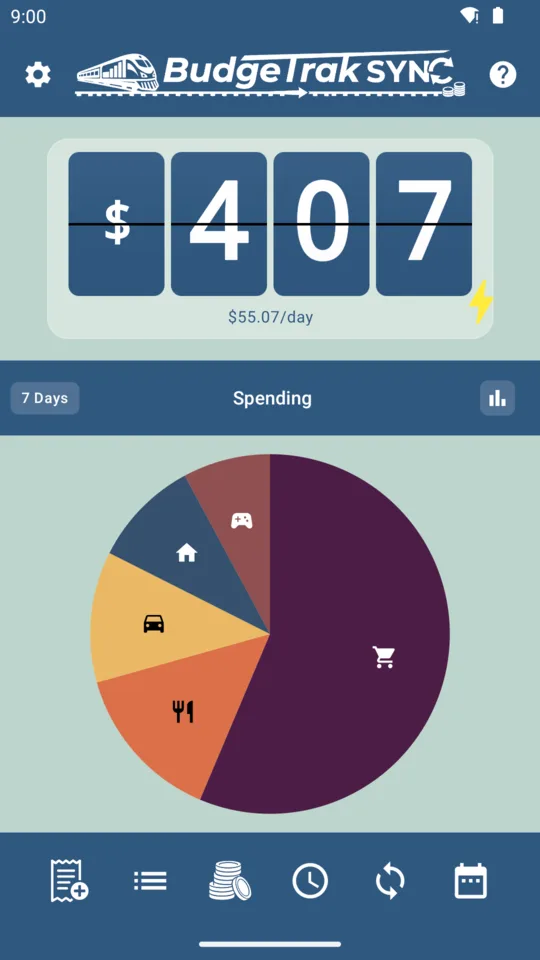
BudgeTrak reserves against your commitments continuously and outputs a single number: what you can spend today. There are categories, but you don’t have to manage them for the system to work. The failure mode is different — it tells you less about where your money goes, because it’s optimised for the decision you make in a shop rather than for the analysis you do on Sunday.
Which is better depends entirely on what you want. If you want to understand your spending in depth, envelopes win. If you want one trustworthy number that two people can both act on, this is a better shape.
Don’t choose BudgeTrak if…
- Anyone in your household has an iPhone. Android only today. iOS is in development and unreleased. This is a hard stop.
- You want automatic capture with no involvement. Bank aggregation genuinely does that better.
- You want to learn a budgeting methodology. YNAB teaches. We compute.
- You need investment or net-worth tracking. Out of scope.
- You want maturity. These are established products with years of polish. We’re new, and new software has rough edges.
Choose it if…
- You don’t want a bank connection, at all, as a matter of principle rather than convenience.
- You’re budgeting with a partner and object to paying a subscription forever for two people to see one number.
- You want the shared copy of your household’s finances to be unreadable by the vendor.
- You want to spend nothing to find out whether it works — the free tier needs no account and has no trial clock.
That last one is the honest recommendation. Set it up on one phone, spend fifteen minutes entering income and bills, and look at the number. If it doesn’t tell you something you didn’t know, you’ve lost fifteen minutes and no money.
Frequently asked questions
What is a good alternative to YNAB for couples?
If your objection to YNAB is the subscription price or the requirement to connect bank accounts, BudgeTrak covers the same core job — a shared, forward-looking household budget — for a $9.99 one-time unlock plus an optional $4.99/month for encrypted multi-device SYNC, with no bank connection at any point. If your objection is that YNAB is too complicated, note that BudgeTrak is a different method rather than a simpler one.
Is BudgeTrak cheaper than YNAB or EveryDollar?
Substantially, for most households. The core budgeting engine is free forever with no account. The one-time $9.99 upgrade costs less than a single month of any of the major subscription apps, and one $4.99/month subscription covers a whole five-device household rather than one seat.
Does BudgeTrak do envelope budgeting like Goodbudget?
Not exactly. Envelope systems divide money into named categories you spend from. BudgeTrak reserves against commitments continuously and outputs a single daily safe-to-spend figure. If you specifically want the envelope metaphor, Goodbudget does it properly and this will feel wrong to you.
Can I switch from YNAB to BudgeTrak?
Your recurring bills and goals need re-entering by hand — roughly fifteen minutes, and it is the part that determines accuracy. Historical transactions can be brought over by CSV import on the Paid tier.
Why would I choose an unknown app over an established one?
Only for specific reasons: you do not want a bank connection, you do not want a per-seat subscription for your partner, or you want end-to-end encryption on shared data. If none of those apply, the established apps have more polish, more integrations and far more community support, and you should use them.
Try the free tier first
No account, no trial clock, no card. Decide after you've seen your own number.
Get it on Google Play