 BudgeTrak
There is a specific argument almost every couple has had. One of you looks at the bank balance, sees a number, and feels fine. The other one knows rent is due Thursday, the car insurance renews next week, and the balance is a lie.
You are both right. You are just looking at a number that doesn’t mean what it appears to mean.
Most budgeting apps built for couples try to solve this by aggregating both your bank accounts into one dashboard. That works — but it asks for something significant in return: the login credentials to every account you own, handed to a third-party data aggregator, so that a company can read your complete transaction history in perpetuity.
Plenty of people are fine with that trade. If you’re not, your options narrow fast. This guide is for you.
What actually makes a budgeting app work for two people
After you strip away the marketing, a shared budget has to do four things. Most apps do one or two.
1. Both partners see the same number, at the same time. Not a weekly summary. Not a report one of you exports and sends to the other. If your partner buys groceries at 6pm, your number should be different at 6.01pm. Otherwise you are both budgeting against stale data and the app is just an expensive spreadsheet.
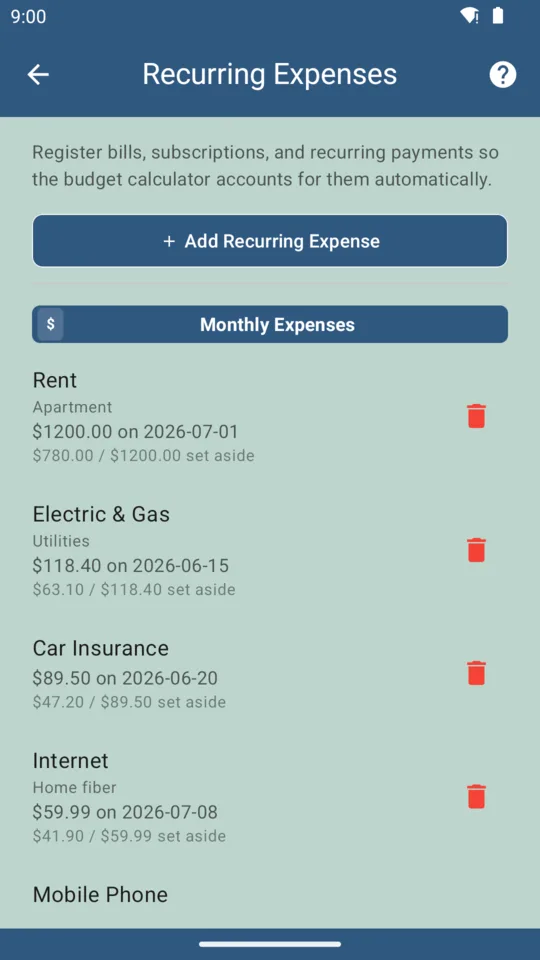
2. The number has to already account for what’s coming. A balance is not a budget. If the app shows you $1,400 without subtracting the rent that leaves on the 1st, it is actively misleading you. The useful number is what’s left after every known commitment is set aside.
3. Each expense is attributable. Not so you can litigate every coffee — so that when the number moves, either of you can see why in three seconds instead of interrogating the other person.
4. It should not require either of you to surrender bank credentials. This is the one most apps simply cannot offer, because their entire data model is built on bank aggregation.
The bank-login problem, stated plainly
When a budgeting app “connects to your bank,” it usually means one of two things: you enter your online banking username and password into a third-party aggregator, or you authorise ongoing read access through a bank portal. Either way, a company that is not your bank now holds durable access to your full transaction history — both partners’, across every linked account.
That is a reasonable trade for automatic categorisation. But notice what you are trading it for: convenience in data entry. Not budgeting accuracy. The maths of a budget doesn’t need your bank at all — it needs to know what you earn, what you owe, and what you’ve spent.
BudgeTrak is built on that observation. It never asks for a bank login, because it never needs one.
To be precise about what we do claim. BudgeTrak has no bank connection and asks for no banking credentials. It is not a zero-network app — SYNC moves encrypted budget data between your own devices, and the optional AI features (receipt scanning, CSV categorisation, help chat) send what you submit to them for processing. What we're saying is narrower and more useful: no company, including us, is reading your bank account.
How two people share one budget in BudgeTrak
You set the budget up once, on one phone. Income, recurring bills, savings goals. The app turns that into a single daily figure — what you can spend today without breaking any commitment you’ve already made.
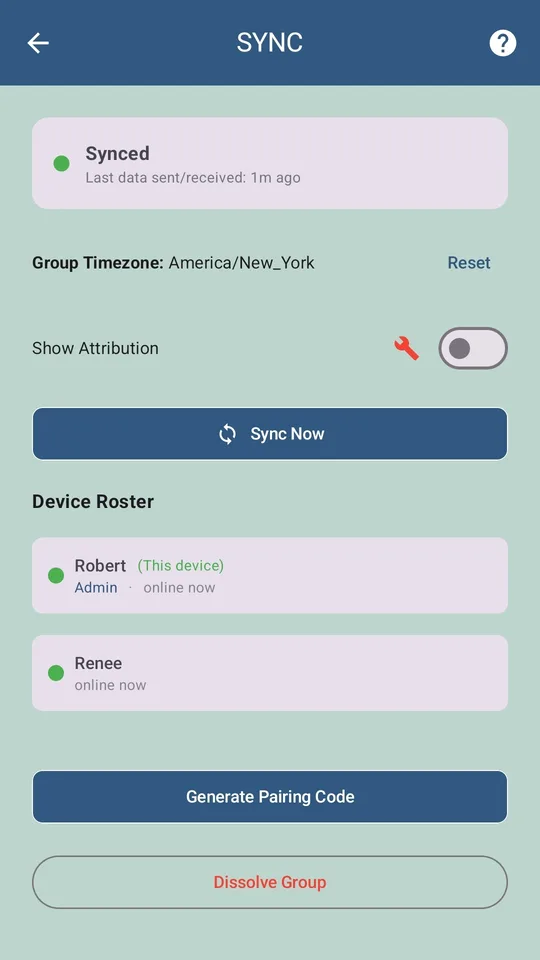
Then you turn on SYNC. One partner subscribes; the other joins with a code on the free tier. From that point both phones hold the same budget, updating in real time, encrypted end to end so the data is unreadable in transit and at rest on our servers.
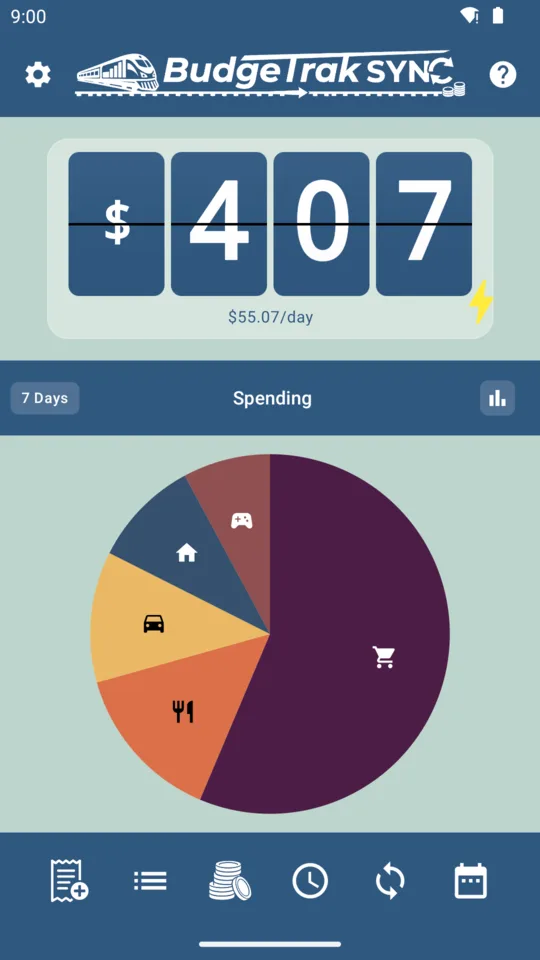
The important detail is the smaller number. Available cash is a balance — interesting, but it’s the number that starts arguments. The daily figure underneath has already had your rent, your bills, your savings goals and any amortised one-off expense removed from it. Spending it to zero every day is by design survivable.
That is the whole point. Neither of you has to hold the household’s commitments in your head, because the app has already subtracted them.
Getting spending in without a bank feed
This is the honest trade-off, so let’s be direct about it. Without bank aggregation, transactions have to reach the app some other way. There are three:
- Log it as you spend. Two taps from the home-screen widget without opening the app. This is the default, and for most couples it takes under a minute a day.
- Import a statement. Download a CSV from your bank whenever you like — weekly, monthly — and import it with duplicate detection and merchant matching. Included in the one-time $9.99 upgrade.
- Let your bank’s own alerts do it. If you already get purchase notifications from your banking app, BudgeTrak can read those notifications on your phone and turn them into pending entries seconds after you tap your card. You review each one before it lands. This needs no bank login, no third-party connection, and no SMS permission — it reads notifications your bank is already sending you. Available on the Subscriber tier.
That third option is the one people underestimate. It gets you most of the automation of a bank feed, days earlier than a statement export, without anyone holding your credentials.
What it costs for two people
| BudgeTrak | Typical couples app | |
|---|---|---|
| Bank login required | Never | Usually mandatory |
| Second partner’s cost | $0 — joins free | Often a second seat |
| Core budgeting | Free forever, no account | Trial, then subscription |
| Shared real-time budget | $4.99/mo for the group | $8–18/mo |
| One-time unlock (import, reports, simulation) | $9.99 once | Not offered |
| Encryption of shared data | End-to-end | Server-side at best |
One subscription covers the household, up to five devices. The partner who joins pays nothing, ever.
Where BudgeTrak is the wrong choice
Worth saying, because you’ll find out in a week anyway:
- You’re on iPhone. Android only today. iOS is in development, unreleased. A mixed household can’t share a budget yet.
- You want fully automatic categorisation with zero input. If the appeal of a budgeting app is that you never touch it, a bank-aggregating app genuinely does that better. We’re a different trade.
- You want investment tracking or net-worth dashboards. Not what this is. This is a spending app.
Start here
If you and your partner have had the “but I thought we had money” conversation more than twice, the fix isn’t more discipline. It’s both of you looking at the same honest number.
Set the budget up on one phone tonight — income, bills, goals. It takes about fifteen minutes. Look at the daily figure together. If it feels wrong, it’s usually because a commitment you’d both forgotten is now visible, which is the app working.
Frequently asked questions
What is the best budgeting app for couples?
The best budgeting app for couples is one that shows both partners the same number in real time, attributes each expense to whoever spent it, and does not require either person to hand over bank logins. BudgeTrak does this with end-to-end encrypted SYNC across up to five devices — one partner subscribes at $4.99/month and everyone else joins free.
Can a couple share a budgeting app without sharing bank passwords?
Yes. Bank aggregation is a design choice, not a requirement. BudgeTrak never asks for bank credentials — you enter income and bills once, and day-to-day spending is captured by hand, by CSV import, or from your bank’s own purchase notifications on your phone. Nothing is connected to your bank.
Do both partners have to pay?
No. Only the person who creates the SYNC group needs the $4.99/month Subscriber tier. Everyone else joins on the free tier and sees the same live budget.
Can we see who spent what?
Yes. Every transaction carries per-member attribution, so the shared ledger shows which device logged each expense. It is a record, not a running argument — the daily number updates for both of you either way.
What if one of us has an iPhone?
BudgeTrak is Android-only today. An iOS version is in development but not released, so a mixed-platform household cannot share a budget yet.
Try BudgeTrak free
No bank login. No ads on paid tiers. Works on Android today.
Get it on Google Play